Wikinvest Wire

Fed Chair Heir Wild Card

Friday, October 07, 2005

With today's jobs report pretty much a bust for its news value - everyone now knows that non-farm payrolls decreased by 35,000 in September, but due to Hurricane Katrina and consequent BLS reporting oddities, no one seems to know how the number was calculated or what it means - we turn our attention to the White House, where the selection process for a new Federal Reserve Chairman continues.

Or, that's what we are led to believe. This was the exchange from President Bush's press conference on Tuesday:

QUESTION: It may be a little early for this, but now that you've gotten your deliberations for the Supreme Court vacancy out of the way, can you talk about the process you're going to use for determining the next chairman of the Federal Reserve?

BUSH: Yes. It's ongoing, by the way. There is a group of people inside the White House who are bringing forth -- who will bring forth nominees.

The nominees will be people that, one, obviously can do the job and, secondly, will be independent.

It's important that whomever I pick is viewed as an independent person from politics. It's this independence of the Fed that gives people, not only here in America but the world, confidence.

And so there's an ongoing process. Right now, I, frankly, hadn't seen any -- personally hadn't seen any names yet because part of the process is to surface some names internally but also part of the process is to reach outside the White House and solicit opinions.

And I'll name the person at an appropriate time.
A group of people either "are bringing forth" or "will bring forth" nominees - this being, apparently, "part of the process to surface names internally". The key element of this process appears to be finding people who "obviously can do the job", obviously - lessons learned from the Katrina-FEMA-Michael Brown debacle we guess. And, independence, that's important too - we're not so sure how "independent" the current Fed Chairman has been, but that's a story for another day.

According to this Forbes article, Vice President Dick Cheney, Chief of Staff Andrew Card, and Karl Rove are currently deliberating over whose names to put on the short list. We can imagine Ben Bernanke pacing the halls, occasionally checking in to see if "the guys" need any coffee or doughnuts - trying not to be a bother, but making sure they know he is there.

Also in the Forbes article is this excerpt - a rather innocuous looking paragraph and a seemingly harmless link, but what a surprise to see where the link goes. Just what kind of shoes are they referring to?
Not to mention the fact that Greenspan leaves big shoes to fill: Soon to be the longest serving Fed chairman ever, he maneuvered the economy through two stock market collapses, two recessions and presided between them over the longest expansions in U.S. history. And he plays a mean sax.
In case your didn't see for yourself, we'll tell you - the above link goes to an article titled "World on the Brink of Ruin", by Dan Ackman, who has penned many interesting doom-and-gloom articles over at Forbes. Either someone over there really has a sense of humor, or this is a not-so-subtle jab at the outgoing Fed Chairman, or both.

But back to today's topic, with everything else that's going on, how much time can the top White House staff be spending deliberating over possible nominees? Let's see, is there anything in the news recently that might in any way impede this effort? Is there anything going on that would possibly distract from this important effort to fill the position that many refer to as the second-most powerful position in the United States?

The Polls
Poll: Bush Ratings Hit New Low

Iraq
U.S. 'Lacks Moral Authority' In Iraq
Iraq Withdrawal 'Catastrophic'
Bush claimed God told him to invade Iraq, Afghanistan: BBC

Terrorism
New York subway under specific threat: mayor

Avian/Pandemic Influenza
Nations to Discuss Potential Flu Pandemic

Hurricane Aftermath
Katrina Contracts Will Be Reopened
No-Bid Deals Questioned on Hill

GOP Divided Over Range and Severity of Spending Cuts

The Valerie Plame Investigation
Rove Said to Testify in CIA Leak Case
FBI Examines Computers in Cheney's Office

The Harriet Miers Nomination
Conservatives Confront Bush Aides
Anger Over Nomination of Miers Boils Over During Private Meetings


Tom Delay
DeLay Meeting, RNC Actions Coincided
Financial Transactions Began on Day Texan Met With Fundraiser


Bill Frist
Frist Sale of Stock Launched in April
Senator and Advisers Discussed It in E-Mail


There is so much going on at the White House these days that it's really hard to imagine that there has been much of a discussion about who should succeed current Fed Chairman Alan Greenspan when he retires in January. It's important, when asked, to leave the impression that this is one of the top priorities within the White House, but let's be realistic.

Some have probably read the papers and discovered that Glenn Hubbard, Martin Feldstein, and Ben Bernanke are the names on the financial media short list, and that's a good first step (imagine Cheney grumbling, "Bernanke, isn't that the guy that keeps wanting to get us coffee and doughnuts?). But, with sagging poll numbers, two Iraqi elections coming up, terrorism threats, a possible flu pandemic, and continuing unrest within the party ranks over the many recent "bumps in the road" ... when it comes to selecting a new Fed Chairman, how can they possibly have time to do anything more than read the papers?

We know very little about this selection process, but feel an overwhelming compulsion to speculate ...

If history is a guide, the nominee will be, first and foremost, loyal to the White House. Independence, shmindependence - these are not normal times. Secondly, due to the Cheney-Miers precedent, where the head of the selection committee ends up selecting themselves, do not rule out Andrew Card - his name was floated some time ago when they were thinking of dumping current Treasury Secretary and uber-salesman John Snow.

Cheney and Rove can be ruled out for obvious reasons, but if Andrew Card is the head of the selection committee, watch out. He can do the job, obviously (that is obvious, isn't it?), and once he leaves the White House, he'll be independent. Plus in another month or two, with all the crises he is currently managing, he may mistakenly view saving the world economy from imploding as a far easier task than to continue his current employment.

The only other real possibility is Ben Bernanke, and his fate really depends on how he is currently perceived over at 1600 Pennsylvania Avenue - loyalty-wise. He's been there for most of the year, and he has faithfully included key components of White House policy in some of his speeches since joining the team, but was that enough? Has he sufficiently proven his loyalty? We'll see.

Our money is on wild card Andrew Card.

Read more...

Alligators and Pythons

Thursday, October 06, 2005

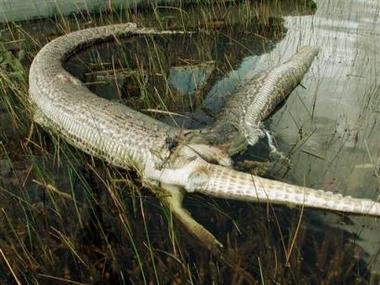
We stumbled across this in the news yesterday.

At first we didn't know quite what to make of it, but after a closer look and some quiet reflection, we couldn't help but notice the parallels between the alligator/python relationship in the Florida Everglades, and the U.S./China relationship in the world economy.

From Yahoo! News

Python Bursts After Trying to Eat Gator

By DENISE KALETTE, Associated Press Writer
Wed Oct 5, 4:04 PM ET

MIAMI - The alligator has some foreign competition at the top of the Everglades food chain, and the results of the struggle are horror-movie messy.

A 13-foot Burmese python recently burst after it apparently tried to swallow a live, six-foot alligator whole, authorities said.


The incident has heightened biologists' fears that the nonnative snakes could threaten a host of other animal species in the Everglades.

"It means nothing in the Everglades is safe from pythons, a top-down predator," said Frank Mazzotti, a University of Florida wildlife professor.

Over the years, many pythons have been abandoned in the Everglades by pet owners.

The gory evidence of the latest gator-python encounter — the fourth documented in the past three years — was discovered and photographed last week by a helicopter pilot and wildlife researcher.

The snake was found with the gator's hindquarters protruding from its midsection. Mazzotti said the alligator may have clawed at the python's stomach as the snake tried to digest it.

In previous incidents, the alligator won or the battle was an apparent draw.

"There had been some hope that alligators can control Burmese pythons," Mazzotti said. "This indicates to me it's going to be an even draw. Sometimes alligators are going to win and sometimes the python will win."

It is unknown how many pythons are competing with the thousands of alligators in the Everglades, but at least 150 have been captured in the past two years, said Joe Wasilewski, a wildlife biologist and crocodile tracker.

Pythons could threaten many smaller species that conservationists are trying to protect, including other reptiles, otters, squirrels, woodstorks and sparrows, Mazzotti said.

Wasilewski said a 10- or 20-foot python also could pose a risk to an unwary human, especially a child. He added, however, "I don't think this is an imminent threat. This is not a `Be afraid, be very afraid' situation.'"
No, we're not suggesting that America will be eaten by China and that we will attempt to claw our way out as we are being digested, causing China to burst, then ultimately finding our hindquarters protruding from their midsection.

Hmmm... Maybe, we'll come back to that.

The similarities that came to mind when we first read this story had more to do with the struggle for dominance over time. For many, many years, the alligator has sat atop the food chain in the Everglades, much like the U.S. has sat atop the world economy. The python is relatively new on the scene, as China is relatively new in the world economy.

Alligators have become accustomed to their role at the top, perhaps becoming a bit complacent over time - gaining weight, making long-term promises they have no apparent way of keeping, going on far-away adventures in an attempt to improve the Everglades.

Pythons seek to challenge that role. Lean and hungry, with a much humbler background, and not distracted as the alligators are, they are in competition with the alligators for limited natural resources.

The two are sure to tangle from time to time.

While pythons have no known manufacturing capabilities, and neither has a currency, the apparently mistaken expectation that alligators would be able to control the python population is telling.

Perhaps, both sides will have to rethink their approaches - reconsider their respective roles in the Everglades. The two now appear to be battling it out to a draw, with the python seemingly having the upper hand in the last conflict, until both ultimately lost the battle.

Read more...

A Legacy of Debt and Delusion

Wednesday, October 05, 2005

Never before have so many borrowed so much.
Never before have so many become so wealthy.
Never before have so many been so deluded.

In recent months, much has been written about the legacy of Federal Reserve Chairman Alan Greenspan, who, after eighteen years, will retire in January. Most of the legacy discussion has been based on the steady hand of the Fed Chairman - a steady hand that has resulted in an era of low reported inflation and mild recessions, while fostering sustained growth through what many have hailed as superb monetary policy.

Others don't see it that way.

Some believe that the Greenspan legacy will be one of debt and delusion - debt of all kinds piled high, lingering far into the future, and delusion in reflecting back, at how we have all behaved during recent years.

Debt

Debt is "money owed". It is present today in huge quantities, for everyone to see - not too many people seem to care. As long as asset prices rise faster than personal debt and there are buyers for U.S. Treasuries, debt just doesn't seem to matter. It just keeps piling up.

It is as if it never has to be paid back.

More debt has been created in recent years than anyone could have possibly imagined just a short time ago. A "culture of debt" has been created - from the Federal Government all the way down to Wal-Mart credit cards.

Over the course of nearly two decades Alan Greenspan has facilitated this debt - he has overseen a system that has supplied the credit that has created the debt that has sustained an entire nation. An entire nation that has been the envy of the world for its dynamic growth. Growth which is based to an ever-increasing degree on new debt creation, and a populace willing to continue its profligacy.

Up until the 1980s, most people probably still agreed with Benjamin Franklin's view toward debt, "Rather go to bed without dinner than to rise in debt", and Adam Smith's wisdom as well, "What can be added to the happiness of a man who is in health, out of debt, and has a clear conscience?"

Today, as individuals and as a nation, we accept debt as an integral and necessary part of a lifestyle to which we have become accustomed, but a lifestyle that we increasingly can not afford.

Wealth

Wealth is defined as "goods and resources having value in terms of exchange or use". Surprisingly, it maintains no relationship with debt. Debt does not offset wealth, they coexist. An individual or a nation can be very wealthy at the same time that they are hopelessly indebted to others. It is under these circumstances that time becomes a factor, as wealth is converted into money to service the debt.

Our nation has acquired much wealth in the last two decades, under the stewardship of Alan Greenspan. The quantity and value of goods and resources has increased dramatically - so has debt. Rising values for stocks and now housing have made many Americans much wealthier than they could have ever imaged just a short time ago.

Spending money borrowed against the rising value of homes has been called the "wealth effect". Many people think they are spending their own money, but this is not the entire story. They are converting their wealth into money, which they can then spend - in the process they have created new debt. They are no less wealthy as a result, in fact, since debt does not offset wealth, they are indeed wealthier - they still have the home, from whence the new debt and new money came, but now they also have more goods that the new money has purchased.

They have become wealthier, and they have acquired more debt.

The wealth effect has been good for our consumption-based economy - many new jobs have been created as a result of converting more and more wealth into money which is then be spent on more goods and services.

One problem with wealth, however, is that it is not constant - it can change over time. Since wealth is based on the value of goods and resources, wealth changes as the market value of these goods and services change. Debt, on the other hand is constant. Debt service can change with fluctuating interest rates, but the debt itself remains as is, until it is added to or paid down.

Delusion

Delusion is the "act of deluding", or "the state of being deluded". Misleading or being misled. One of the difficulties with this terminology is the tense. By definition, one can not knowingly be deluded or misled - it is only after the fact, when one is wiser and takes time to reflect back, that the delusion is recognized and understood.

Some people believe that today's high housing prices and hence individual wealth, have become far detached from fundamentals and are not likely to continue into the future. They feel that the masses are being misled - not with respect to the current wealth of homeowners, this is real, but in the expectation that housing prices will maintain current levels or continue to rise.

There are questions about whether current wealth will endure.

Many people believe there is nothing unusual about a home, unchanged from five years ago, which is now valued at say, $300,000 more than it was then. It is valued at this level because other people are able and willing to pay that much for similar homes, and hence the homeowner, who may also be unchanged from five years ago, is now $300,000 wealthier than before. Moreover, the homeowner believes his current wealth will be projected into the future.

Time and stability have a way of reinforcing beliefs such as these.

Most homeowners today truly feel wealthy; otherwise we would not see home-equity driven consumption at the levels that have been witnessed in recent years. If they suspected that maybe they were being misled regarding their prospects for continued wealth, they likely would not spend this wealth at current rates.

Legacy

A legacy is something that is "transmitted or received from a predecessor". Like delusion, it is does not really work in the present tense - it is only after the predecessor has left the scene that one knows, factually, what the legacy of the predecessor is. Any discussion of the legacy of a contemporary is just speculation.

So, what kind of legacy will Alan Greenspan leave? Surely it will be a legacy of debt. There is so much debt at all levels - personal, business, government - and this debt will not go away quickly. It will linger, and it will need to be serviced. Will it all be repaid? Likely not. Many individuals are in far over their heads and do not have the same advantage that the government has in paying future debt with a currency which loses value.

But what else will the legacy consist of?

The legacy could also consist of continued wealth - current wealth could continue at these levels or rise as we charge into the future. But that depends on many factors. Most individuals today are wealthy due to rising real estate prices - if this trend does not continue, or worse, reverses, much of this wealth could disappear.

The Fed Chairman has been warning of this scenario often lately.

With the way individuals have unwittingly overextended themselves recently, it is a good bet that much of this wealth will disappear in the years ahead - that many loans will go bad, home prices will decline, and wealth will decrease.

So, can housing wealth be replaced with wealth created from some other source?

After the 1980s bond and real estate boom went bust, it was replaced with a technology boom. After the 1990s technology boom went bust, it was replaced with another bond and real estate boom. If the most recent boom goes bust, what will replace it?

That is the key question.

If there is something to replace housing as a source of wealth in the future - a technology boom in renewable energy, or nanotechnology perhaps - then in the years ahead the Greenspan legacy may be thought of as one of debt and wealth. Not bad really.

As long as wealth stays ahead of the debt, things will be fine. This has worked well so far.

However, if in the years ahead, it becomes clear that there is no new asset class that can be inflated to generate wealth for the millions and millions of Americans accustomed to rising debt to support their standard of living, then maybe people will look back at this period of time and think that maybe they have been misled.

Maybe people will come to understand that they behaved in ways that they shouldn't have because they were led to believe that their current wealth was based on sound fundamentals and that it would endure. Maybe people will realize that they were duped into acting in ways that they now regret and were swept up in a mania, the likes of which the world has never seen before. The Great Real Estate Bubble.

At that point, they will realize that they were misled, deluded.

This is the scenario that seems to make more sense - that the Greenspan legacy will be one of debt and delusion.

Read more...

The California SUV Fill-Up Index - $2.90

Tuesday, October 04, 2005

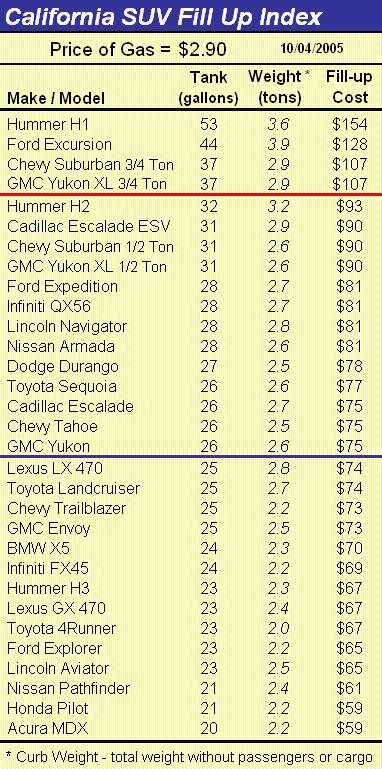
After reading this and this a couple days ago, we figured we'd better get about the business of updating our California SUV Fill-Up Index before we fall hopelessly behind in our promise to provide an update with each ten cent rise in gasoline prices.

Based on a very unscientific survey in the last day or two, it appears that we are erring a bit on the low side by calling it at $2.90 for regular unleaded, however, this is reasonably close to what consumers are paying.

As discussed in previous posts on this subject here and here, the real action for the near term is going to be around the $75 mark. As you can see in the updated chart, the Toyota Sequoia has now breached this level along with three General Motors behemoths:


Speaking of General Motors behemoths, this report on September auto sales appeared yesterday. Should it be surprising that Chevy Tahoe sales were off 50 percent from the same period last year? A summer of employee discounts surely had an impact on September sales, but it does look like gas prices are starting to influence consumer automobile purchases.

Ahhh... the markets are working their magic.

Chrysler seems to have done reasonably well last month. Not coincidentally, to be sure, they have only one entry in our index - the Dodge Durango.

With a number of popular Ford products also high on the index, this is starting to feel like the 70s and 80s all over again. Back then it was models like the Datsun B210 that Americans were buying. Today, the redesigned Honda Civic adds to Japanese market share while American manufacturers struggle with outdated products.

Environmentally Friendly SUVs

Most of the new $75+ fill-up SUVs have such outdoorsy, environmentally friendly sounding names - Sequoia, Tahoe, Yukon. It sounds like you're out in the wilderness, far from civilization - the smell of pine trees in the air, listening to the crackling of wood in a fireplace, and gazing at the stars - not on the way home from work riding someone's bumper at 75 miles an hour in the fast lane trying to make it to the PTA meeting on time.

Even Escalade sounds like something light and agile, not like something weighing nearly three tons without driver, passengers, or cargo.

And, that Toyota... it does sound strange to say, "I just spent $75 to fill up my T0yota"

You'll notice that we've replaced the fuel economy column with curb weight. There were some questions about the accuracy of the fuel economy claims provided by the manufacturers, which we had dutifully transcribed in the previous version of this chart. Some owners commented that their mileage was not in the mid-teens, but the low-teens. We were unable to successfully resolve these inconsistencies, but we were sympathetic.

We're guessing that most owners haven't weighed their SUVs lately, and that the curb weight numbers provided will be less controversial.

As for the fill-up process itself, it has recently come to our attention that for some reason, at least in California, the maximum amount that gas stations allow to be charged on a credit card for a single transaction is $60. What this must mean is that in order to get a full load of gas into an empty tank for most of the SUVs above, the owner must insert their credit card, select the fuel grade, pump the gas, complete the transaction, and then repeat.

What a pain!

Worse yet, to completely fill the Hummer H1 and Ford Excursion, this would actually require three complete transactions at today's prices. That must take a fair amount of time, but with today's prices, most H1 and Excursion owners probably don't bother with the third transaction - after $120, their tanks are full enough.

That may not be true in the future.

Read more...

Like Cropping the Mona Lisa

Monday, October 03, 2005

We set out today wanting to talk about last Friday's commentary by Stephen Roach regarding two speeches made by Alan Greenspan earlier in the week. Normally we would pick out a few passages and excerpt them here, then add a few thoughts of our own in an attempt to enhance the overall experience of deriding the Fed Chairman for his many sins.

Today, we experienced unexpected difficulty in taking this tack.

After reading this commentary a first time, then a second time more slowly and more carefully, we attempted to formulate a plan to dissect this work to best suit our purposes here. Selecting the first paragraph was easy - it is a neat five-sentence summary of the entire commentary, and would serve as a convenient launching point for some irreverent observation or theory that would come naturally once we got started.

So far, so good.

Then a problem arose.

Selecting excerpts requires, by its nature, that other portions be omitted - this is where we ran into trouble.

Paragraphs 2 & 3 and 4 & 5 are Mr. Roach's two central conclusions from Mr. Greenspan's two speeches. That is, that the Fed Chairman has acknowledged:

  1. The magnitude of recent asset bubbles and their impact on both national savings and the trade deficit.
  2. That the monetary policies of the Federal Reserve may well have created these asset bubbles.
Upon re-reading this part of the commentary many times in search of portions that could be jettisoned, it soon became clear that these four paragraphs are so masterfully constructed that any attempt to exclude any portion would be akin to cropping a jpeg of the Mona Lisa.

Where would you start? Why would you do it?

The final three paragraphs address the Fed Chairman's ongoing revisionist history (shaping a legacy, as we've called it here) and discuss the dangers associated with the transition to a new Fed Chief early next year. Here too, we find ourselves unable to exclude any of this well-crafted, insightful, possibly prophetic prose.

The commentary is provided in its entirety below. Even if you have already read it, we recommend reading it at least one more time, two, if you can spare the extra few minutes.
Global: Batonless

Stephen Roach (New York)


The Maestro has dropped his baton. In a series of stunning about-faces, Federal Reserve Chairman Alan Greenspan has just recast his perceptions of the critically important relationship between monetary policy and asset markets. Not only does he finally own up to the perils of America’s housing bubble, but he now concedes that speculative froth in asset markets may well have been a direct outgrowth of the Fed’s policy stance. These revisionist views are in stark contrast to the Chairman’s public stance over the last decade. This raises profound questions about the Greenspan legacy and also underscores the tough problems that are about to be passed on to his successor.

The first step in this two-part confession came in the form of a rare research paper just published by the Chairman and a Fed staffer (see Alan Greenspan and James Kennedy, “Estimates of Home Mortgage Originations, Repayments, and Debt on One-to-Four-Family Residences,” September 2005). On one level, this is a very technical paper, providing a detailed statistical decomposition of the sources of mortgage lending activity in the US. But on another level, it reveals the full force of one of the key drivers of the Asset Economy -- equity extraction from residential property. According to the Greenspan-Kennedy framework, US homeowners tapped the ever-expanding home equity till to the tune of about $600 billion in 2004 -- equivalent to about 7% of disposable personal income, or more than double the 3% share recorded in 2000. In a companion speech, Greenspan goes on to concede that this equity extraction from ever rising property values was large enough to have accounted for all of the decline in the personal saving rate since 1995 (see his 26 September speech, “Mortgage Banking”).

Bingo! It then follows that the substitution of asset-based saving (i.e., home equity extraction) for income-based personal saving created a major shortfall in national saving. And what is a saving-short US economy to do under such circumstances? Two choices -- curtail investment and grow more slowly or stay the course by importing surplus saving from abroad and running massive current-account deficits to attract that capital. Of course, it was an easy choice for the world’s leading economy -- witness America’s gaping current-account deficit running at close to an $800 billion annual rate in the first half of 2005. But with this easy choice has come tough consequences -- namely, a US current account deficit that accounts for fully 70% of all the external deficits in today’s unbalanced world. In short, equity extraction has spawned the “mother” of all imbalances -- not just for the US but for the global economy at large. This, in my view, is when asset bubbles become most destructive -- when they create distortions and dangers that transcend the asset class itself. America’s housing bubble and its current account deficit are joined at the hip -- and the rest of the world is being sucked into the funding side of the equation. And Alan Greenspan has just figured that out?

But that pales in comparison to the second step in this two part confession -- Greenspan’s admission that the Fed’s monetary policy stance may have played an important role in fostering asset bubbles and the imbalances they engender. In what he refers to as “the greatest irony of economic policymaking” the Chairman has also come around to the conclusion that success can breed peril -- or that sustained very low levels of nominal interest rates can give rise to asset bubbles (see his 27 September speech, “Economic Flexibility”). But this is not a shocker to anyone else. At low levels of inflation and the equally low levels of nominal interest rates that accompany such an outcome, excess liquidity can become a much more powerful force in shaping asset values than otherwise might be the case. The IT- and Internet-enabled technological breakthroughs were the icing on the cake in taking productivity growth higher and, as a result, in pushing inflation and interest rates lower.

So after all these bubbles, Greenspan finally gets it. Yes, under certain conditions, equity valuations can be turbo-charged by monetary accommodation. Those stars were in perfect alignment in the latter half of the 1990s. The Fed chairman appears to have come to the same realization with respect to property bubbles. Even couched in all the caveats of Fedspeak, this is a stunning admission for a central banker who has long been against the targeting of asset values. This gets to what I have long felt was Greenspan’s most egregious policy blunder -- failing to use the tools of monetary policy to nip the first bubble in the bud back in the late 1990s (see my 25 April 2005 dispatch, “Original Sin”).

What is particularly galling about this aspect of the confession is Greenspan’s effort to re-write the role he personally played during this era of froth. In his 27 September speech on flexibility, he notes, “As the FOMC transcripts of the mid-1990s duly note, we at the Fed were uncomfortable with a stock market that appeared as early as 1996 to disconnect from its moorings.” If the Chairman shared this discomfort, as the “we” in that statement seems to suggest, then why was he taking on the role ofcheerleader as the Nasdaq spiked toward 5000? Don’t forget this is the same central banker who proudly proclaimed in early 2000, “We may conceivably conclude from that vantage point that, at the turn of the millennium, the American economy was experiencing a once-in-a-century acceleration of innovation, which propelled forward productivity, output, corporate profits, and stock prices at a pace not seen in generations, if ever” (see his 13 January 2000 speech, “Technology and the Economy”). Selective recall or not, Alan Greenspan was the pied piper of the New Paradigm and the equity bubble it spawned. And up until recently, he took a similar tack with respect to the property bubble -- constantly maintaining that excesses in certain local real estate markets could not morph into a nationwide problem. With 25 states plus the District of Columbia now in double-digit house price appreciation mode over the last year, the Fed chairman suddenly sees the light!

Greenspan, of course, will not be there to pick up the pieces. That unfortunate task falls to his successor -- whomever that may be. History tells us that even under the best of circumstances, transitions to a new Fed chairman are fraught with peril. Financial markets are quick to test the new central banker. That was certainly the case when Alan Greenspan took over in August 1987 -- the stock market crashed two months later. That was also the case when Paul Volcker became chairman in August 1979 -- the bond market quickly tanked. And the onset of G. William Miller’s brief tenure in March 1978 ushered in a dollar crisis. Just from that perspective alone, there’s good reason to worry about the markets in early 2006. But there’s an even greater reason to worry about the coming transition to a new Fed chairman. Courtesy of bubble-induced distortions that Greenspan condoned, today’s saving and current-account disequilibria dwarf anything that a new chairman has had to face in the past. The average net national saving rate that Miller, Volcker, and Greenspan inherited was 7.4%; today it is 2% and likely to be a good deal lower in early 2006. Similarly, America’s current account deficit averaged -1.5% of GDP in the three most recent Fed chairmen transitions; today, it is closer to -6.5%.

In the end, America’s current-account funding problem remains very much a confidence game. To the extent, the confidence of foreign lenders is shaken as it normally is by the transition to a new Fed chairman, America’s unprecedented imbalances imply that financial market risks could be all the more acute. That could be the cruelest legacy of all for Alan Greenspan to leave to his successor. Right about now, the Maestro could certainly use a new baton.

Read more...

The Gold/Greenspan Convergence

Sunday, October 02, 2005

There's a nice article about gold by Tom Petruno in this morning's L.A. Times.

This is the first we've heard the phrase "Gold/Greenspan Convergence". With all the talk about new 18 year highs for gold and the end of Fed Chairman Alan Greenspan's 18 year term coming near, we are disappointed in ourselves for not coming up with it first.

Nice work Tom!

This is a very well-reasoned story that includes a brief, yet seemingly still obligatory segment about "gold bugs as tin-foil hat wearing lunatics", this time making reference to survivalists and shotguns. In what is surely a sign of things to come, the article goes on to do a fine job of debunking this perception of gold, casting the yellow metal in a much more serious light, citing trends in recent mutual fund investment flows.

Look for more articles like this in the future, as more and more people look at gold in a much different way, given current world events. Here are some excerpts:

The last time an ounce of gold cost $470, Alan Greenspan was in his first year as chairman of the Federal Reserve.

Seventeen years later, Greenspan is on the verge of retiring — and the metal finally is back to its late-1980s price level, after a long, long bear market.

The gold/Greenspan convergence is raising suspicions on Wall Street. Some believe the metal's revival must be saying something about the economy the Fed chief is leaving to his as-yet unnamed successor.
On calamities and shotguns:
Indeed, any kind of economic calamity that would make people question the viability of national currencies, particularly the dollar, would most likely be great for gold, at least initially.

To go too far down that road, however, is to enter the realm of the survivalists and others who believe the end of the world as we know it is imminent. If that day were to come, let's face it, you'd probably be smarter to own shotguns than gold bullion.

Jim Melcher, president of money management firm Balestra Capital in New York, owns gold and is no fan of U.S. markets. But he also says he isn't planning for Armageddon.

Melcher views gold in the same light as foreign currencies and foreign stocks: a way to diversify against the risk that the U.S. is overstretched financially because of its massive trade and budget deficits and will increasingly struggle to compete with the rest of the world.

"This is no longer a country in a growth phase," he says. "You've got to invest where there's growth."

That's harsh, and many trillions of dollars of investment in the U.S. say Melcher's wrong.

Even so, consider what the average U.S. mutual fund investor has been doing: Americans invested nearly twice as much in foreign stock funds in the first half of this year as in domestic stock funds, according to the Investment Company Institute.
On portfolio diversification:
There may be an undercurrent of fear in investors' gold purchases, but it may be less a fear of catastrophe than a recognition that the global economic and market landscapes are changing, and the outcome is uncertain.

The metal was a terrible investment in the 1990s as inflation dwindled and financial assets roared. Now, there are enough questions about inflation and the outlook for financial assets to at least make gold a contender as investors think about how to divide their portfolio pie.

Read more...

Now Here's Something Odd

Saturday, October 01, 2005

We were surprised to see this photo. Tony Blair, sure. Condoleeza Rice, yes. But President George W. Bush? Perhaps there was nothing else handy to help pass the time while in transit, or maybe, due to press accounts of his reading habits, we underestimate him.

Nevertheless, here it is:

George Bush reading The Economist magazine!

In an attempt to remain politically neutral, we leave it to readers to provide the sardonic wit or staunch support - we were just a little surprised.


Read more...
IMAGE

  © Blogger template Newspaper by Ourblogtemplates.com 2008

Back to TOP